The Top 5 Acupressure Points Everyone Should Know
If you only ever learn five acupressure points in your life, make them these five. Between them, they cover headaches, nausea, stress, cramps, and that specific kind of tension that makes you want to lie face-down on the floor of a Target.
Consider this your cheat sheet — the "break glass in case of bad day" edition.
A quick housekeeping note before we dive in: acupressure points have official numbered names (LI4, SP6, and so on) that look like they belong on a parking garage level, not a body part. Don't let that intimidate you — I'll tell you exactly where each one is located and what it actually feels like when you've found it.
1. LI4 (Large Intestine-4 or He Gu) — The One Everyone Already Knows, Whether They Realize It or Not
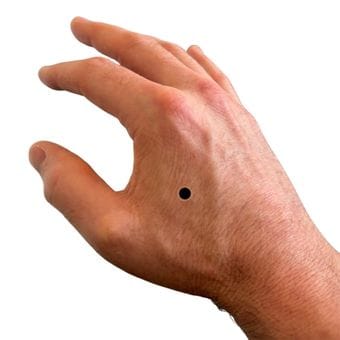
Where it is: The fleshy webbing between your thumb and index finger, on the back of your hand. Squeeze your thumb and index finger together and you'll see a little muscle mound pop up - that's your landmark - push into that mound and you will be right there. For a “practitioner-level” explanation into the location of LI4 - see my LI4 acupuncture point location article.
What it's for: Headaches, toothaches, facial pain, and general "everything hurts and I don't know why" tension. This is probably the single most-used point in all of acupuncture, and for good reason — it's ridiculously easy to find and does a lot of heavy lifting.
How it should feel: With strong pressure, you should notice a deep, slightly achy feeling — almost a "hurts so good" sensation. If it feels sharp or genuinely painful, you're pressing too hard or slightly off-target.
One important safety note: LI4 is one of the most well-known contraindicated points in pregnancy. If you're pregnant, skip this one entirely — I go into exactly why in my full LI4 breakdown over on Acupuncture Masterclass.
2. SP6 (Spleen-6 or San Yin Jiao) — The Overachiever of the Lower Leg
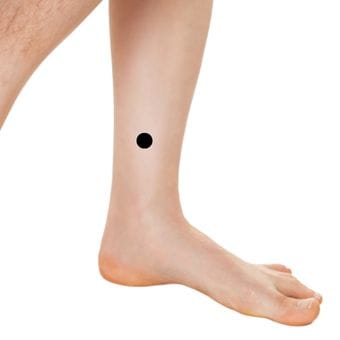
Where it is: About four finger-widths above the inner ankle bone, just behind the shin bone. Not directly on the bone — slightly behind it, in the soft tissue. For my “practitioner-level” explanation for this point - see my SP6 acupuncture point location article.
What it's for: This point is the intersection of three different energy channels (hence the name, which literally means "three yin meeting"), which is a fancy way of saying it does a lot. Digestive issues, sleep troubles, menstrual cramps, general fatigue — SP6 shows up in more treatment plans than almost any other point I use in clinic.
How it should feel: Similar to LI4 — a deep, dull ache rather than a sharp pain.
Same safety note applies here too: SP6 is also contraindicated during pregnancy, for the same underlying reason as LI4. These two points get name-dropped together constantly for exactly that reason — more detail in my full safety guide.
Dealing with headaches? Get my free guide to the acupressure points that actually help.
Free Headaches Guide →Bloating, cramping, sluggish digestion? There's a free guide for that too.
Free Digestive Guide →3. PC6 (Pericardium-6 or Nei Guan) — The Nausea Point With the Receipts
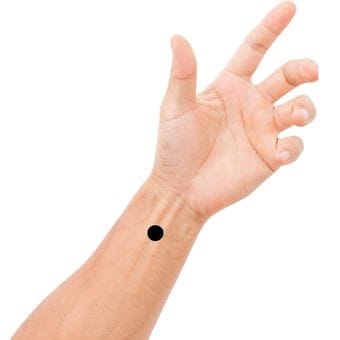
Where it is: On the inner forearm, about three finger-widths up from the wrist crease, between the two visible tendons. For my “practitioner-level” explanation for this acupuncture point, see my PC6 article here.
What it's for: Nausea. Motion sickness, morning sickness, post-surgery queasiness, the "I probably shouldn't have gone on that roller coaster" feeling — PC6 is the point with genuinely the strongest research behind it out of everything on this list. This isn't folklore; there are real clinical trials on this one. Those wristbands you see people wearing on cruise ships? That's PC6, commercialized.
How it should feel: A firm, steady pressure. Circular rubbing motions work particularly well here.
Bonus fact: This is also a calming point, so it pulls double duty for anxiety and that pre-flight spiral of "did I lock the front door."
4. Yin Tang — The Point Between Your Eyebrows You've Been Unconsciously Rubbing for Years
Where it is: Right between your eyebrows - it’s that simple. If you've ever pinched or rubbed the bridge of your nose during a stressful meeting, congratulations — you've been doing acupressure without a certificate.
What it's for: Stress, anxiety, headaches (especially forehead headaches), and general mental fog. This is less about a specific ailment and more about hitting the body's "please calm down" button.
How it should feel: Firm, sustained pressure — this one doesn't need to be aggressive to work. Think "calm, steady thumb," not "trying to touch my brain."
Fun fact: Yintang isn't even on one of the twelve main meridians — it's what's called an "extra point," discovered through centuries of practitioners noticing "huh, that spot seems to help" and writing it down anyway. Sometimes the folk wisdom gets there first.

5. LV3 (Liver-3 or Tai Chong) — The Point for When You're Just... Irritated
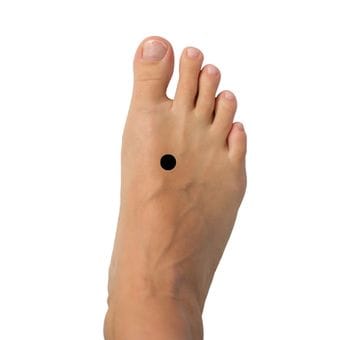
Where it is: On the top of your foot, in the groove between your big toe and second toe, about two finger-widths up from where the toes separate. For my “practitioner-level” explanation on this point, see my LV3 acupuncture point article.
What it's for: Stress, irritability, tension headaches, and — pair this with LI4 and you get what's traditionally called the "Four Gates" combination, one of the most commonly used pairings in the entire system for pain and emotional tension together. [LINK: I've written a full breakdown of that combination here.]
How it should feel: This one can be more tender than the others — many people find LV3 genuinely sensitive even with light pressure. If it feels sore, that's actually pretty normal here; just don't go looking for a bruise afterward.