
Acupressure for Labour: 5 Points to Help Encourage Labour at Home
The last days of pregnancy can feel like the longest. You've reached your due date, your bag is packed, and the question becomes: is there anything I can do to help things along?
Want more details on Acupressure for Labour - plus special bonuses?
Download my free Acupressure for Labour guide – step-by-step photos, a daily routine, partner instructions and a special routine for once labour begins.
Your email address is safe with us . We never share your information with anyone
Acupressure is one of the gentlest options for labour support.
It uses the same points acupuncturists have relied on for centuries to support the body as it prepares for labour – but instead of needles, you (or your partner) use steady finger pressure. It's simple, free, and can be done at home.
I'm Drew Nesbitt, a registered Traditional Chinese Medicine practitioner and acupuncturist in Toronto. Labour and pregnancy support has been a big part of my clinical practice for over 20 years.
Below are the five points I teach most often for encouraging labour, how to find them, and how to use them safely.
First: Is Acupressure for Labour Right for You?
These points are traditionally avoided during pregnancy until it's time for labour. Only use them once you've reached your due date (40 weeks), or earlier if your midwife or OB has said it's appropriate.
Check with your care provider before starting if you have placenta previa, any bleeding during this pregnancy, a baby who isn't head-down, a previous C-section, twins, high blood pressure, or a pregnancy considered high-risk for any reason.
And set realistic expectations: acupressure may help your body prepare for labour, but it can't force labour to start if your body and baby aren't ready. Think of it as support, not a switch.
How Acupressure Is Thought to Help
In Traditional Chinese Medicine, labour depends on the smooth movement of Qi and Blood, and on the body being able to relax and let go. The points used for labour are chosen to encourage that downward movement and to calm the nervous system – because tension and worry tend to hold the body back.
How to Press the Points
Pressure: firm and steady – not light touch, not painful. You're looking for a deep, spreading ache, often described as a "good hurt."
Time: 45–60 seconds per point, on each side. Short pauses every 10 seconds or so are fine.
How often: once or twice a day.
Position: side-lying with pillows supporting the head, belly and knees is ideal. Avoid lying flat on your back in late pregnancy.
Never press on the belly, and ease off any point that feels sharp or burning.
Most people press too lightly or too briefly – which is the main reason acupressure "doesn't work." Slow down and take your time with each point.
The 5 Acupressure Points for Labour
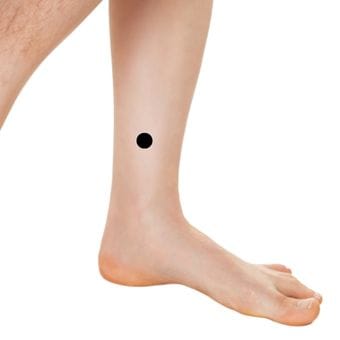
SP-6 (San Yin Jiao) – "Three Yin Meeting"
Where: On the inner leg, four finger-widths above the tip of the inner ankle bone, just behind the edge of the shin bone.
How: If side-lying, your partner can reach the inner ankle of your bottom leg easily. On your own, sitting cross-legged is usually easiest.
What you'll feel: A deep ache, often quite tender. SP-6 is one of the most widely used points for women's health in Chinese medicine.
LI-4 (He Gu) – "Joining Valley"
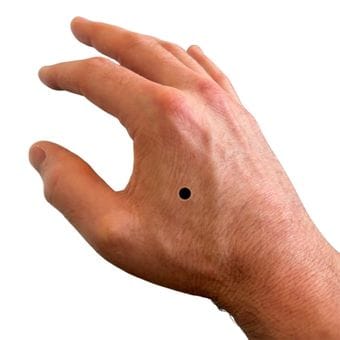
Where: On the back of the hand, in the fleshy web between the thumb and index finger, pressing into the muscle slightly closer to the index finger.
How: Rather than pinching, support the hand and press straight in with your thumb, angling slightly toward the index finger bone. Search for the strongest ache, then hold.
What you'll feel: A strong, deep ache, sometimes spreading toward the fingers. This is one of the strongest-feeling points in acupuncture, so expect a noticeable sensation.
BL-60 (Kun Lun) – "Kunlun Mountains"
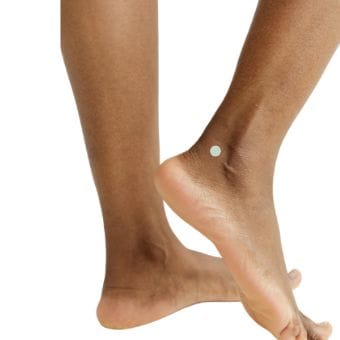
Where: On the outer ankle, in the hollow between the tip of the ankle bone and the Achilles tendon.
How: Press into the hollow with your thumb or index finger, directing pressure slightly toward the ankle bone.
What you'll feel: A local ache that may spread toward the heel.
BL-32 (Ci Liao) – "Second Crevice"
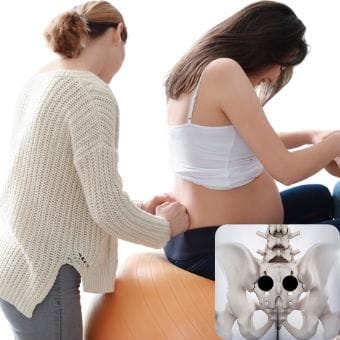
Where: On the sacrum (the flat, triangular bone at the base of the spine). Find the two dimples at the top of the buttocks, then move about a thumb-width down and slightly in toward the spine – you'll feel a small hollow on each side.
How: This is a partner point. With you side-lying or leaning forward, your partner presses both sides at once with their thumbs.
What you'll feel: A deep, spreading pressure across the low back. BL-32 is also one of the most helpful points once labour begins (see below).
GB-21 (Jian Jing) – "Shoulder Well"
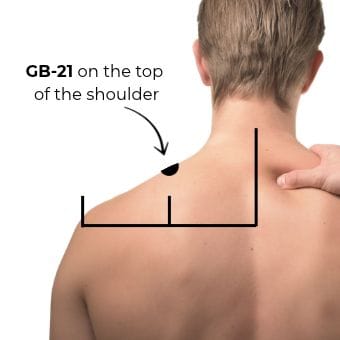
Where: On the top of the shoulder, halfway between the base of the neck and the tip of the shoulder, at the highest point of the muscle.
How: Your partner presses down with their thumbs or rests their forearms on the area. Look for the most tender spot – that's usually the point.
What you'll feel: A strong ache that may spread up toward the head. Save this point for last – it's the strongest.
Want more details on Acupressure for Labour - plus special bonuses?
Download my free Acupressure for Labour guide – step-by-step photos, a daily routine, partner instructions and a special routine for once labour begins.
Your email address is safe with us . We never share your information with anyone
A Simple Daily Routine
Slow belly breathing for 1–2 minutes – breathe in for 4, out for 6–8, no holding.
SP-6 – 45–60 seconds each side
LI-4 – 45–60 seconds each side
BL-60 – 45–60 seconds each side
BL-32 – 45–60 seconds (partner)
GB-21 – 45–60 seconds each side
The whole routine takes about 15 minutes. Once or twice a day is plenty.
Once Labour Begins: Acupressure for Comfort
The same points can help once labour is underway – this time for comfort.
During contractions: firm, steady pressure on BL-32 and the sacrum is often the most appreciated technique of all.
Between contractions: gentle pressure on Yin Tang (between the eyebrows), light strokes across the forehead, and slow breathing together.
Popular hands-on techniques like the double hip squeeze and counter-pressure aren't part of Chinese medicine, but they pair well with acupressure. Ask your midwife, doula or prenatal instructor to show you – or search them by name for demonstrations.
Listening to Your Body
If your waters break or contractions become regular, that's often a sign labour is starting – follow the plan you've made with your care provider. Pause and call your midwife or OB if you notice any bleeding, less movement from baby, strong pain, a headache with vision changes or swelling, or you simply don't feel like yourself.
Dealing with headaches? Get my free guide to the acupressure points that actually help.
Free Headaches Guide →Bloating, cramping, sluggish digestion? There's a free guide for that too.
Free Digestive Guide →